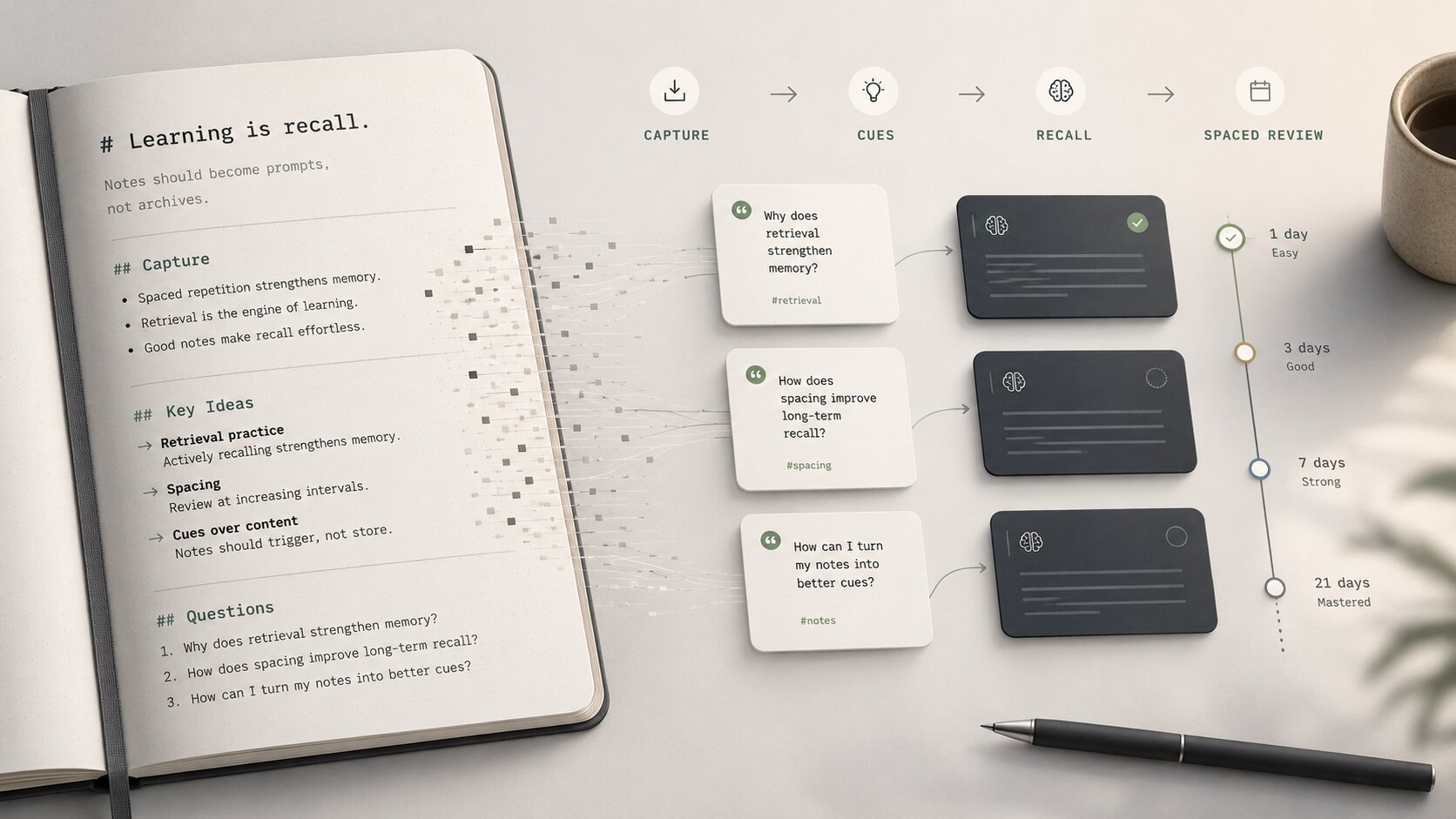
Most note-taking tools optimize for capture.
They make it easy to write more, clip more, paste more, summarize more, and store more. That is useful, but it is not the same thing as learning. A note can be beautifully organized and still do almost nothing for memory. It can be searchable, tagged, linked, and archived — while the idea itself never becomes available in your head when you need it.
The better question is not:
How do I take more complete notes?
It is:
What kind of note will make me think again later?
That shift matters. The strongest learning science does not point toward prettier notebooks or larger archives. It points toward a loop:
flowchart LR
    A[Capture] --> B[Compress]
    B --> C[Question]
    C --> D[Recall]
    D --> E[Review]
    E -. strengthens .-> C
The most effective notes are not passive records. They are prompts for future retrieval.
That is the core idea behind recall-based note-taking.
The problem with ordinary notes
Ordinary notes often feel productive because they create visible output. A page fills up. A transcript grows. A highlight count increases. A folder becomes more organized.
But visible output can hide weak learning.
When you reread a note, the material feels familiar. That familiarity can be mistaken for understanding. You recognize the sentence, so you assume you know the idea. You see the highlighted passage, so you assume it is stored somewhere useful.
But recognition is not recall.
Recall is what happens when the source is gone and you still have to reconstruct the idea. You need to explain the concept in a meeting, implement it in code, solve a problem, defend an argument, or connect it to something else you know. At that point, the note itself is not enough. The knowledge has to be retrievable.
This is where many note-taking systems fail. They help us keep information outside the mind, but they do not reliably train the mind to retrieve it.
What the research says
The research base is larger than note-taking itself. The most useful findings come from cognitive psychology: retrieval practice, spacing, generative learning, and note-taking studies.
1. Retrieval practice is one of the strongest learning tools
A major review by Dunlosky, Rawson, Marsh, Nathan, and Willingham evaluated common learning techniques and rated practice testing and distributed practice as high-utility strategies across a range of learners and materials.1
The key idea is simple: trying to remember something is not merely a way to check whether you know it. The act of retrieval helps strengthen future retention.
Roediger and Karpicke’s work on test-enhanced learning showed this clearly: memory tests do more than assess learning; they can improve long-term retention.2
For notes, this means the note should not only contain information. It should contain prompts that force recall.
2. Spacing beats cramming
The spacing effect is also well supported. Cepeda and colleagues reviewed hundreds of distributed-practice assessments and found broad evidence that spreading learning over time improves retention compared with massing study into one session.3
The practical conclusion is straightforward: a good note should come back later.
Not all at once. Not only when you remember to reread it. The note should produce a small review event after time has passed:
today → tomorrow → a few days later → next week → next monthtoday → tomorrow → a few days later → next week → next monthThe exact schedule can vary. The important part is that review is distributed and recall-based.
3. Generative learning matters
Learning improves when people actively make sense of material instead of merely receiving it. Fiorella and Mayer describe generative learning as activities that require learners to select, organize, and integrate information with prior knowledge. Examples include summarizing, mapping, drawing, self-testing, self-explaining, teaching, and enacting.4
This gives us another useful principle:
Notes should make the learner generate structure.
That means writing in your own words, producing examples, asking questions, identifying failure modes, and explaining why something works.
A transcript is not generative. A copied paragraph is not generative. A good cue question is.
4. Handwriting often helps, but the medium is not the whole story
The laptop-versus-longhand debate is useful, but it is often oversimplified.
Mueller and Oppenheimer found that students taking notes on laptops tended to transcribe more verbatim and performed worse on conceptual questions than students taking notes longhand.5 A 2024 meta-analysis by Flanigan and colleagues found that handwritten lecture notes were associated with higher achievement than typed notes, while typed notes produced much higher note volume.6
That does not mean paper is magic.
Morehead, Dunlosky, and Rawson later ran a direct replication and extension of the Mueller and Oppenheimer study and found a more nuanced result, cautioning against a simple “longhand always wins” conclusion.7
The more useful takeaway is this:
Handwriting often helps because it slows people down and forces selection, compression, and rephrasing.
Software can support the same cognitive behavior. A digital note-taking app can nudge people away from transcript mode and toward cue generation, summaries, and review.
5. Cornell-style notes are useful because of the loop, not the page layout
Cornell notes are often presented as a template: cues on the left, notes on the right, summary at the bottom. That structure can help, but the layout is not the main mechanism.
The mechanism is that Cornell notes ask the learner to generate cues, summarize ideas, and review later.
Recent work comparing note-taking methods is mixed. A 2026 randomized study comparing Cornell, parallel, digital, and sentence note-taking methods found limited differences immediately after learning, though the Cornell group outperformed the sentence-method group on delayed retention.8
So the practical lesson is not “everyone must use Cornell notes.”
The lesson is:
Make cues, summarize, recall, and review.
That workflow can live in a notebook, a classroom handout, a Markdown file, or a keyboard-first notes app.
The technique: cue-recall notes
A recall-based note has five parts.
1. Capture the idea
2. Compress it in your own words
3. Turn it into questions
4. Reconstruct it from memory
5. Review it later on a spaced schedule
1. Capture the idea
2. Compress it in your own words
3. Turn it into questions
4. Reconstruct it from memory
5. Review it later on a spaced scheduleThis is not a complicated system. It is a different default.
Instead of asking, “Did I save this?” ask:
Can I answer a useful question about this later without looking?
Step 1: Capture less, but capture better
The first mistake is trying to write everything down.
Complete notes are not always better notes. More words can mean more transcription and less thinking. During capture, the goal is to identify the high-signal material:
- the core claim
- the mechanism
- the example
- the distinction
- the edge case
- the failure mode
- the implication
- the thing you are likely to forget
For technical material, good notes often include:
- inputs and outputs
- invariants
- assumptions
- minimal examples
- counterexamples
- tradeoffs
- debugging clues
For philosophical or conceptual material, good notes often include:
- the thesis
- the argument
- the objection
- the distinction
- the consequence
- the author’s strongest example
- your own critique
Capture should be compressed. You are not trying to preserve the entire source. You are trying to create the conditions for understanding it again later.
Step 2: Turn notes into questions
A question changes the note from a record into a training device.
A weak note says:
Gradient descent updates parameters by stepping against the gradient.Gradient descent updates parameters by stepping against the gradient.A stronger note says:
> [!question] What problem does gradient descent solve?
> It minimizes a differentiable objective by iteratively updating parameters in the direction that locally reduces the loss.
> [!question] What problem does gradient descent solve?
> It minimizes a differentiable objective by iteratively updating parameters in the direction that locally reduces the loss.Now the note can test you.
Good cue questions are specific enough to be answerable and deep enough to require reconstruction. They should not only ask for labels. They should ask for relationships, causes, examples, and boundaries.
Weak cues:
What is gradient descent?
What is spaced repetition?
What is the Cornell method?
What is gradient descent?
What is spaced repetition?
What is the Cornell method?Better cues:
What problem does gradient descent solve?
Why can a high learning rate cause divergence?
How is recognition different from recall?
Why does spacing improve retention compared with cramming?
What does the Cornell method force the learner to do?
When would a note-taking system create an illusion of competence?
What problem does gradient descent solve?
Why can a high learning rate cause divergence?
How is recognition different from recall?
Why does spacing improve retention compared with cramming?
What does the Cornell method force the learner to do?
When would a note-taking system create an illusion of competence?The best cues make you explain.
Step 3: Write a short summary
After capture, write a short summary from memory.
Not a polished essay. Not a full rewrite. Just three to five sentences that answer:
What is the main idea?
Why does it matter?
How does it work?
What should I remember later?
What is the main idea?
Why does it matter?
How does it work?
What should I remember later?The summary is not only for future reading. It is a first retrieval attempt.
If you cannot summarize the idea shortly after encountering it, the note is not finished. You may have recorded words, but you have not yet made the idea stable.
Step 4: Do blank recall
Blank recall is simple:
- Hide the source.
- Hide the note.
- Write what you remember.
- Compare.
- Correct gaps.
This feels harder than rereading because it is harder. That difficulty is the point. It reveals what is actually retrievable.
A blank recall section can be plain Markdown:
## Blank Recall

### 2026-06-11

Gradient descent is used to minimize a loss function by updating parameters against the gradient. The learning rate controls the step size. If it is too high, updates can overshoot and diverge. If it is too low, convergence can be very slow.

### Corrections

- I forgot to mention that the gradient is local information.
- I need an example of a non-convex loss surface.
## Blank Recall
### 2026-06-11
Gradient descent is used to minimize a loss function by updating parameters against the gradient. The learning rate controls the step size. If it is too high, updates can overshoot and diverge. If it is too low, convergence can be very slow.
### Corrections
- I forgot to mention that the gradient is local information.
- I need an example of a non-convex loss surface.This is where the illusion of understanding breaks. That is useful. The correction becomes the next cue.
Step 5: Review on a spaced schedule
A note should not disappear after you write it.
The simplest useful review schedule is enough to start:
flowchart LR
    A([Same day]) --> B([1 day]) --> C([3 days]) --> D([1 week]) --> E([2 weeks]) --> F([1 month])
During review, do not reread first. Answer first.
flowchart TD
    Q[Question] --> A[Attempt answer from memory]
    A --> R[Reveal note]
    R --> G{Grade recall}
    G -->|Again / Hard| S([Schedule sooner])
    G -->|Good / Easy| L([Schedule later])
    S --> Q
    L --> Q
A review should feel like a small test, not like browsing an archive.
The grading can be simple:
Again: I could not answer it.
Hard: I got part of it, but with effort or errors.
Good: I answered correctly.
Easy: I answered quickly and confidently.
Again: I could not answer it.
Hard: I got part of it, but with effort or errors.
Good: I answered correctly.
Easy: I answered quickly and confidently.The grade controls when the question appears again.
What this looks like in Markdown
Recall-based notes do not need a proprietary format. They can live in ordinary Markdown.
---
tags: [learning, machine-learning]
study:
  status: active
  next_review: 2026-06-12
---

# Gradient Descent

## Capture

Gradient descent minimizes a differentiable objective by repeatedly updating parameters in the direction opposite the gradient.

The learning rate controls the step size. Too high can cause divergence; too low can make learning slow.

## Cues

> [!question] What problem does gradient descent solve?
> It minimizes a differentiable objective by using local gradient information to update parameters toward lower loss.

> [!question] Why can a high learning rate cause divergence?
> Because updates can overshoot useful regions of the loss surface, producing oscillation or larger loss instead of convergence.

> [!question] What does the learning rate control?
> The size of each parameter update.

## Summary

Gradient descent is an optimization method for reducing a differentiable loss function. It uses the gradient as local slope information and updates parameters in the opposite direction. The learning rate determines step size and strongly affects convergence.

## Blank Recall

### 2026-06-11

Gradient descent uses gradients to update parameters toward lower loss. The learning rate controls how large each step is. A large rate can overshoot; a small rate can make training slow.

### Corrections

- Add a worked example.
- Add a note about local minima and non-convex surfaces.
---
tags: [learning, machine-learning]
study:
status: active
next_review: 2026-06-12
---
# Gradient Descent
## Capture
Gradient descent minimizes a differentiable objective by repeatedly updating parameters in the direction opposite the gradient.
The learning rate controls the step size. Too high can cause divergence; too low can make learning slow.
## Cues
> [!question] What problem does gradient descent solve?
> It minimizes a differentiable objective by using local gradient information to update parameters toward lower loss.
> [!question] Why can a high learning rate cause divergence?
> Because updates can overshoot useful regions of the loss surface, producing oscillation or larger loss instead of convergence.
> [!question] What does the learning rate control?
> The size of each parameter update.
## Summary
Gradient descent is an optimization method for reducing a differentiable loss function. It uses the gradient as local slope information and updates parameters in the opposite direction. The learning rate determines step size and strongly affects convergence.
## Blank Recall
### 2026-06-11
Gradient descent uses gradients to update parameters toward lower loss. The learning rate controls how large each step is. A large rate can overshoot; a small rate can make training slow.
### Corrections
- Add a worked example.
- Add a note about local minima and non-convex surfaces.This is still a normal note. It is readable in any Markdown editor. But it also contains the pieces needed for active recall.
Why this fits ZenNotes
ZenNotes is built around plain local Markdown files, keyboard-first editing, and workflows that keep the user close to the text.
That makes it a natural fit for recall-based note-taking.
The goal is not to turn notes into a separate flashcard database. The goal is to make learning behavior native to the note itself.
A good product workflow could look like this:
write note → type /cue → add question → review due prompts laterwrite note → type /cue → add question → review due prompts laterOr:
select paragraph → create cue → answer from memory → schedule reviewselect paragraph → create cue → answer from memory → schedule reviewOr:
open daily note → see due recall prompts → review in five minutesopen daily note → see due recall prompts → review in five minutesThe note remains a Markdown file. The learning loop sits on top of it.
This matters because many study tools split knowledge into separate systems. Notes live in one place. Flashcards live in another. Tasks live somewhere else. Over time, the workflow becomes heavy enough that people stop using it.
A lightweight Markdown-native approach keeps the loop close:
The source, the summary, the cue, and the review history all belong to the same note.The source, the summary, the cue, and the review history all belong to the same note.How AI should help — and where it should not replace the learner
AI can be useful in this workflow, but it should not do the thinking for the user.
The risky version of AI note-taking is:
record everything → summarize everything → save everything → never think about it againrecord everything → summarize everything → save everything → never think about it againThat optimizes capture, not learning.
A better use of AI is to support retrieval:
suggest cue questions
find weak sections
ask Socratic follow-ups
quiz the user
compare a blank recall attempt against the source
identify missing concepts
suggest cue questions
find weak sections
ask Socratic follow-ups
quiz the user
compare a blank recall attempt against the source
identify missing conceptsThe important constraint is that the learner still has to generate answers.
For example, AI can suggest:
What is the main claim of this note?
What example supports it?
What would you confuse this with?
What is the failure mode?
How would you explain this without using the original terms?
What is the main claim of this note?
What example supports it?
What would you confuse this with?
What is the failure mode?
How would you explain this without using the original terms?But the user should answer, revise, and decide what belongs in the note.
A tool that writes the note for you may save time. A tool that makes you recall the idea helps you learn.
A practical template
Here is a simple template for recall-based notes:
---
tags: [learning]
study:
  status: active
---

# {{title}}

## Source

- Type:
- Author / speaker:
- Link:
- Date:

## Capture

Write compressed notes here. Avoid transcript mode.

## Cues

> [!question] What is the central claim?
>

> [!question] Why does this matter?
>

> [!question] What is an example?
>

> [!question] What would I confuse this with?
>

> [!question] When does this fail?
>

## Summary

Three to five sentences in your own words.

## Blank Recall

### {{date}}

Reconstruct the idea without looking.

## Corrections

-

## Related Notes

- [[ ]]
---
tags: [learning]
study:
status: active
---
# {{title}}
## Source
- Type:
- Author / speaker:
- Link:
- Date:
## Capture
Write compressed notes here. Avoid transcript mode.
## Cues
> [!question] What is the central claim?
>
> [!question] Why does this matter?
>
> [!question] What is an example?
>
> [!question] What would I confuse this with?
>
> [!question] When does this fail?
>
## Summary
Three to five sentences in your own words.
## Blank Recall
### {{date}}
Reconstruct the idea without looking.
## Corrections
-
## Related Notes
- [[ ]]The template is intentionally small. The power is not the structure by itself. The power is the repeated act of answering the questions.
The principle
A good note is not the note that contains the most information.
A good note is the note that gives you the right mental work at the right time.
That means:
less transcription
more compression
fewer highlights
more questions
less rereading
more recall
less cramming
more spacing
less transcription
more compression
fewer highlights
more questions
less rereading
more recall
less cramming
more spacingNotes should not merely preserve what you once saw.
They should help you become the kind of person who can use it later.
That is the difference between a notes archive and a learning system.
ZenNotes already makes it easy to write in plain Markdown. The next step is to make it just as easy to remember what those notes were supposed to teach.
References
Dunlosky, J., Rawson, K. A., Marsh, E. J., Nathan, M. J., & Willingham, D. T. (2013). Improving Students’ Learning With Effective Learning Techniques: Promising Directions From Cognitive and Educational Psychology. Psychological Science in the Public Interest. PubMed ↩
Roediger, H. L., & Karpicke, J. D. (2006). Test-Enhanced Learning: Taking Memory Tests Improves Long-Term Retention. Psychological Science. PubMed ↩
Cepeda, N. J., Pashler, H., Vul, E., Wixted, J. T., & Rohrer, D. (2006). Distributed Practice in Verbal Recall Tasks: A Review and Quantitative Synthesis. Psychological Bulletin. PubMed ↩
Fiorella, L., & Mayer, R. E. (2016). Eight Ways to Promote Generative Learning. Educational Psychology Review. ERIC ↩
Mueller, P. A., & Oppenheimer, D. M. (2014). The Pen Is Mightier Than the Keyboard: Advantages of Longhand Over Laptop Note Taking. Psychological Science. PubMed ↩
Flanigan, A. E., Wheeler, J., Colliot, T., Lu, J., & Kiewra, K. A. (2024). Typed Versus Handwritten Lecture Notes and College Student Achievement: A Meta-Analysis. Educational Psychology Review. Springer ↩
Morehead, K., Dunlosky, J., & Rawson, K. A. (2019). How Much Mightier Is the Pen than the Keyboard for Note-Taking? A Replication and Extension of Mueller and Oppenheimer (2014). Educational Psychology Review. ERIC ↩
Yıldırım, M. (2026). The Effects of Note-Taking Methods on Lasting Learning: The Role of Motivation and Cognitive Load. Frontiers in Psychology. PMC ↩